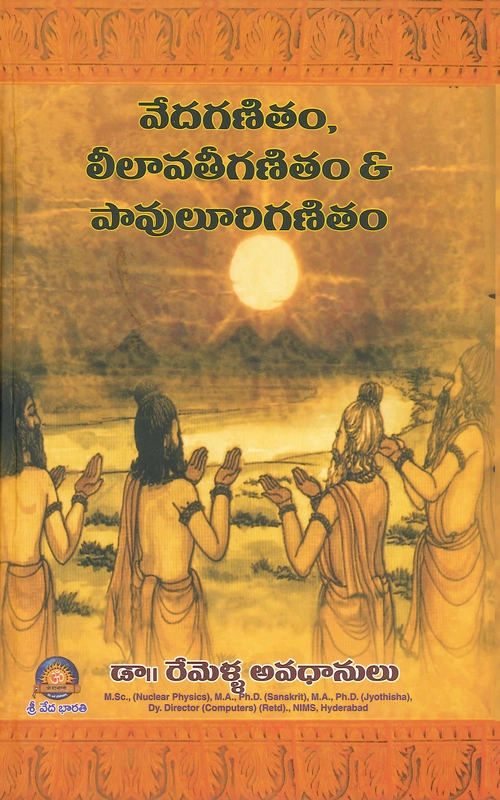


వేదగణితం, లీలావతిగణితం, పావులూరి గణితం Vedic Mathmatics, Lilavathi Ganitham & Paavuluri Ganitham
The subject of Vedic Mathematics has become a household name in recent years. The term indicates that mathematics which has its origin in the Vedas. Our sages in ancient times discovered several mathematical principles and incorporated the same in our Vedic literature. Recently in 1960’s, Swami Bharathi Krishna Tirtha of Govardhan peetha of Puri Jagannath, authored a book titled “Vedic Mathamatics”, elaborating 16 sutras mainly.
About 1000 years back, Paavuluri Mallanna explained several mathematical processes in Telugu poetry, which are relevant even today. Similarly about 900 years back Bhaskaracharya – 2, authored a book called “LilavathiGanitam” which is highly useful in getting the concepts and methods for finding solutions for mathematical problems.
The book “Vedic Maths, PavuluriGanitam, LilavathiGanitam” is highly useful for learning superfast methods for some arithmetic operations, which in turn helps the students appearing for competitive examinations.
The book appears as a single volume in telugu, and as a set of 5 parts in English.
Vedic Maths Volume – 1 gives some Introduction, Simple Practice of Numbers, Multiplication Tables & Digital Roots, Multiplications, EkadhikenaPurvena, Antyoyor dasakepi, EkaNyunenaPurvena, Positional Notation in Vedas etc.,
Vedic Maths Volume – 2 gives some Numbers in Sanskrit, Complement – Nikhilam, Digital Root, Multiplications (by 5, 11,12, 25, 50, 125) etc.,
Vedic Maths Volume – 3 give some Multiplications (with 8, 9, 15, 18 etc.,) Divisions (by 5, 9, 25, 15), Infinity, Prime and Composite Numbers, HCF & LCM etc.,
Vedic Maths Volume – 4 gives some Squares (11 type, 22 type, 101 type), Square Roots, Percentage, Percentile, Profit and Loss, Contributions of Indian Mathematiciens etc.,
Vedic Maths Volume – 5 gives some Cubes, Cube Roots, Fourth order Roots, Introduction to Algebra, Decimal Number System in Vedas, Indian Algebra in Magic Squares etc.,